Getting started
On this page
The open-source stack for branded instant quotes and pricing estimators.
Build interactive pricing calculators, publish them under your own brand, embed them on your website, and keep control of your customer data. OpenQuoteStack is self-hosted software for service businesses, agencies and developers; basic operation needs PostgreSQL and no proprietary cloud service.
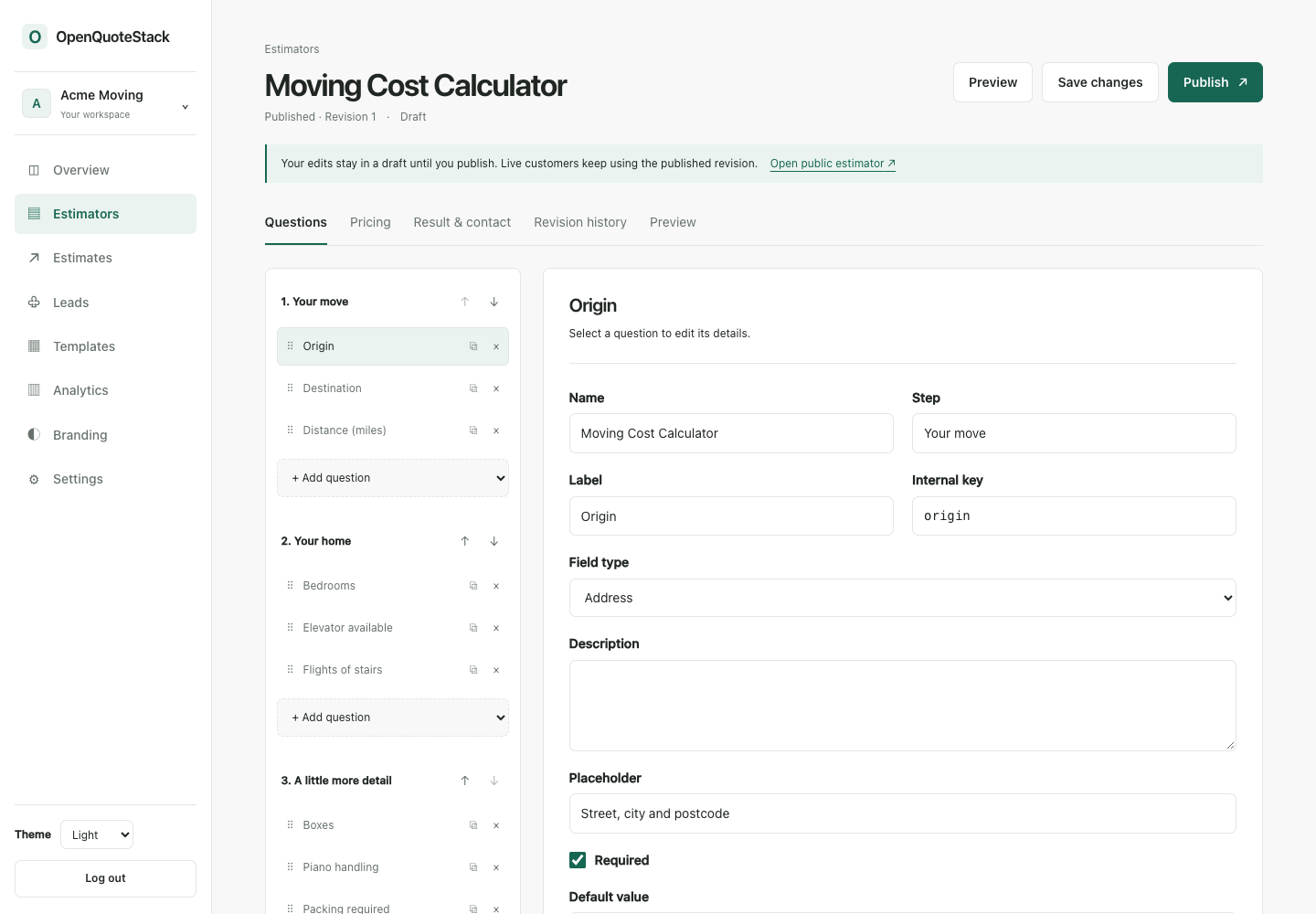
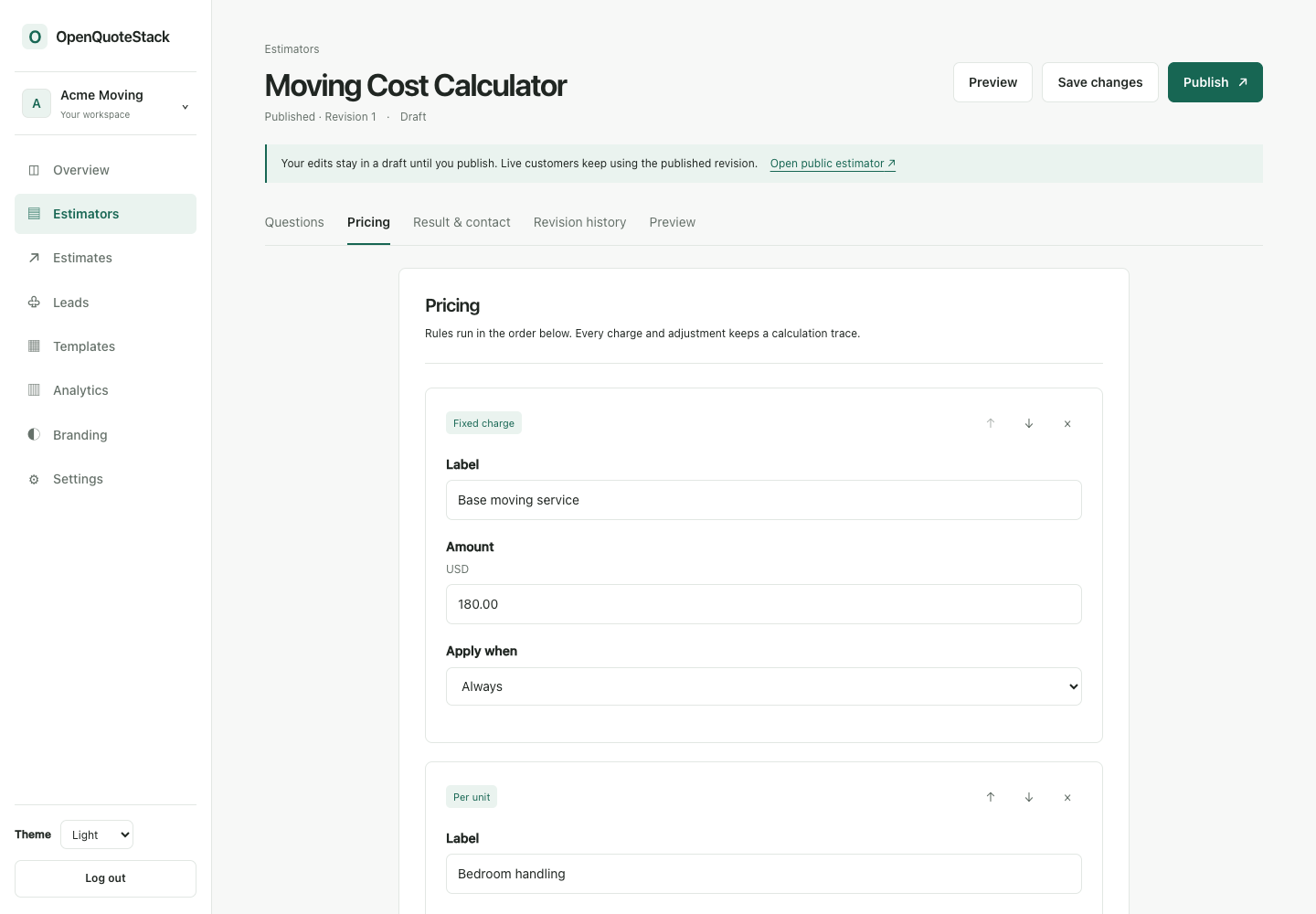
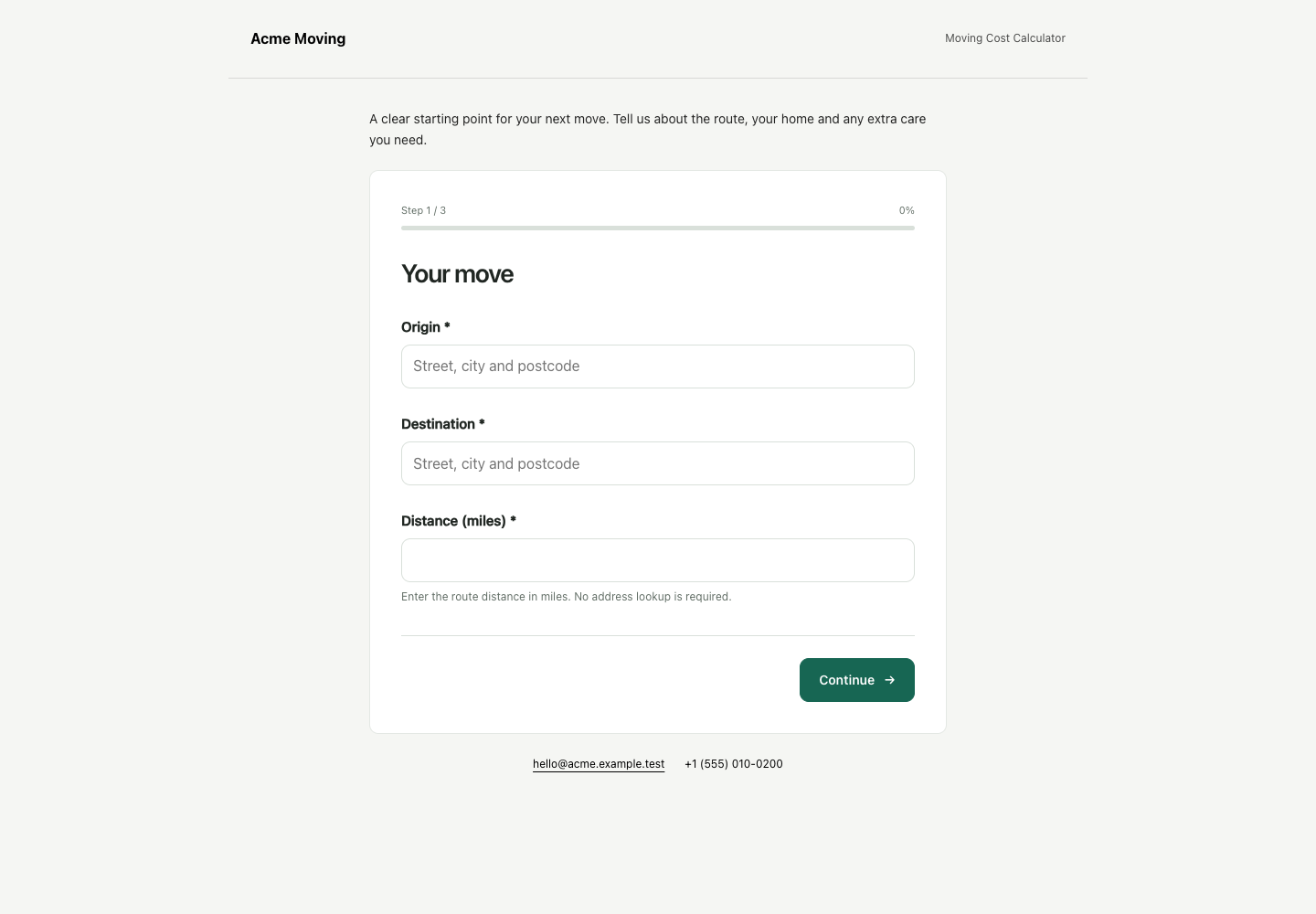
Real application views with fictional data: dashboard, pricing rules, public calculator, Portuguese result, and analytics.
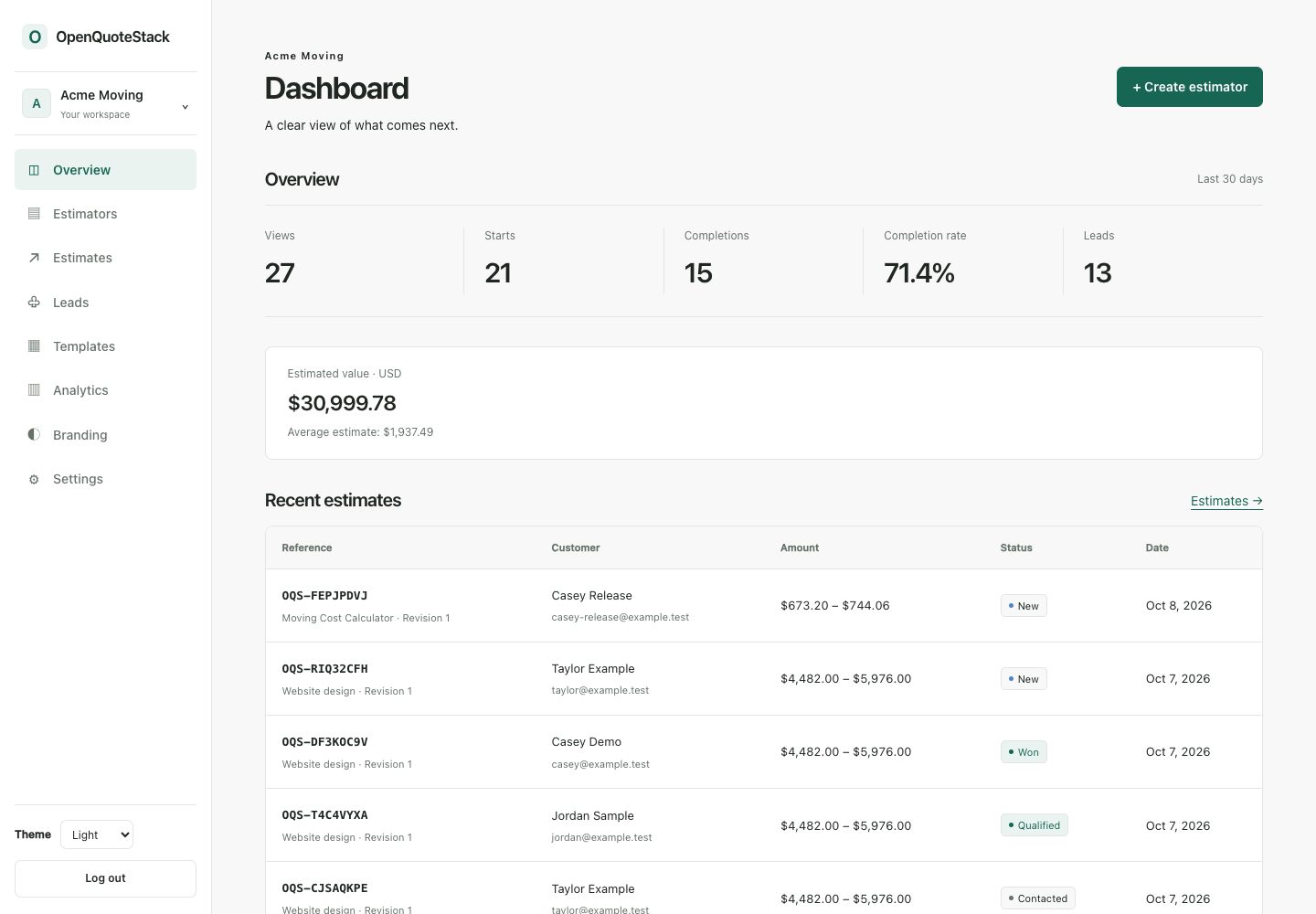
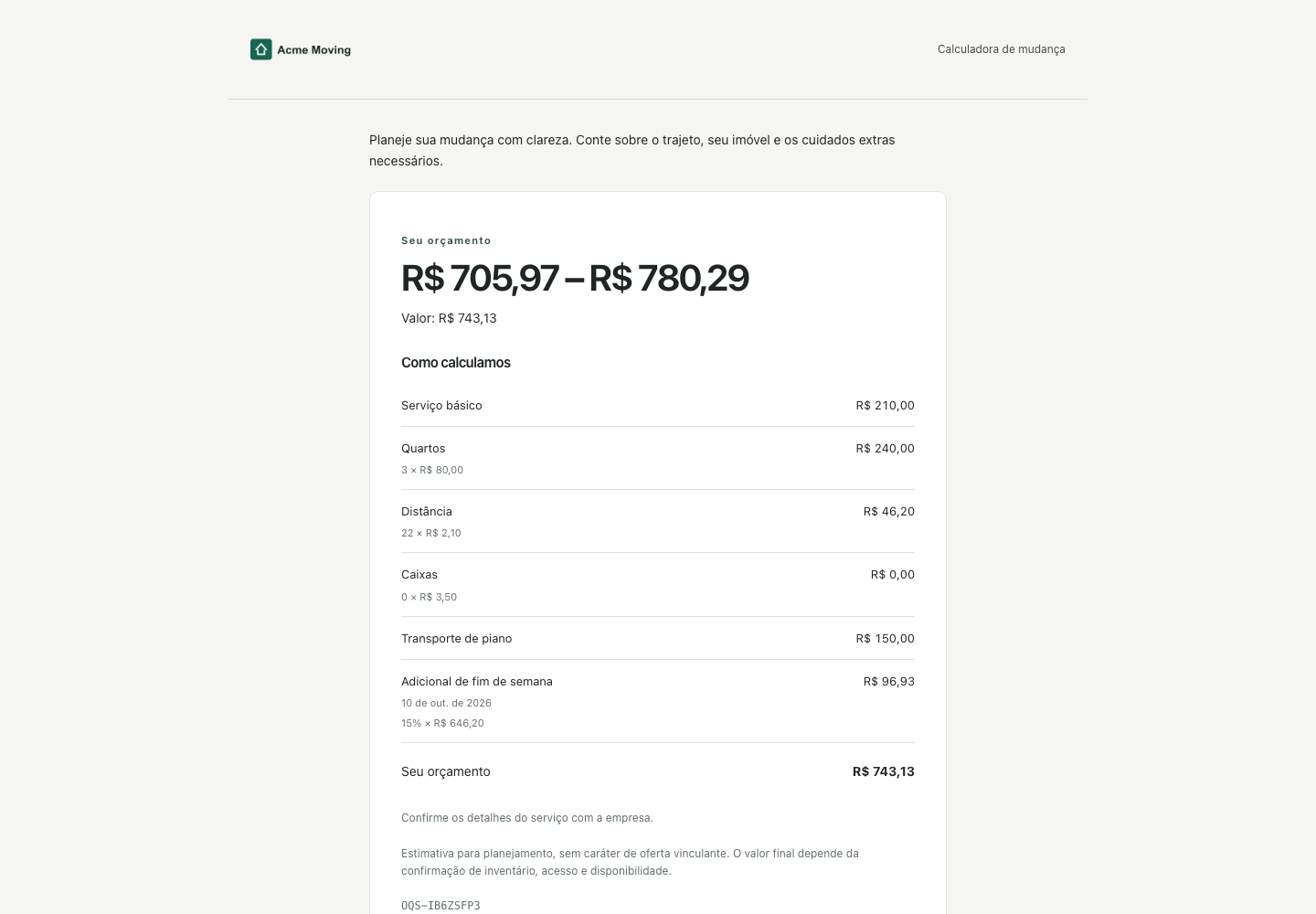
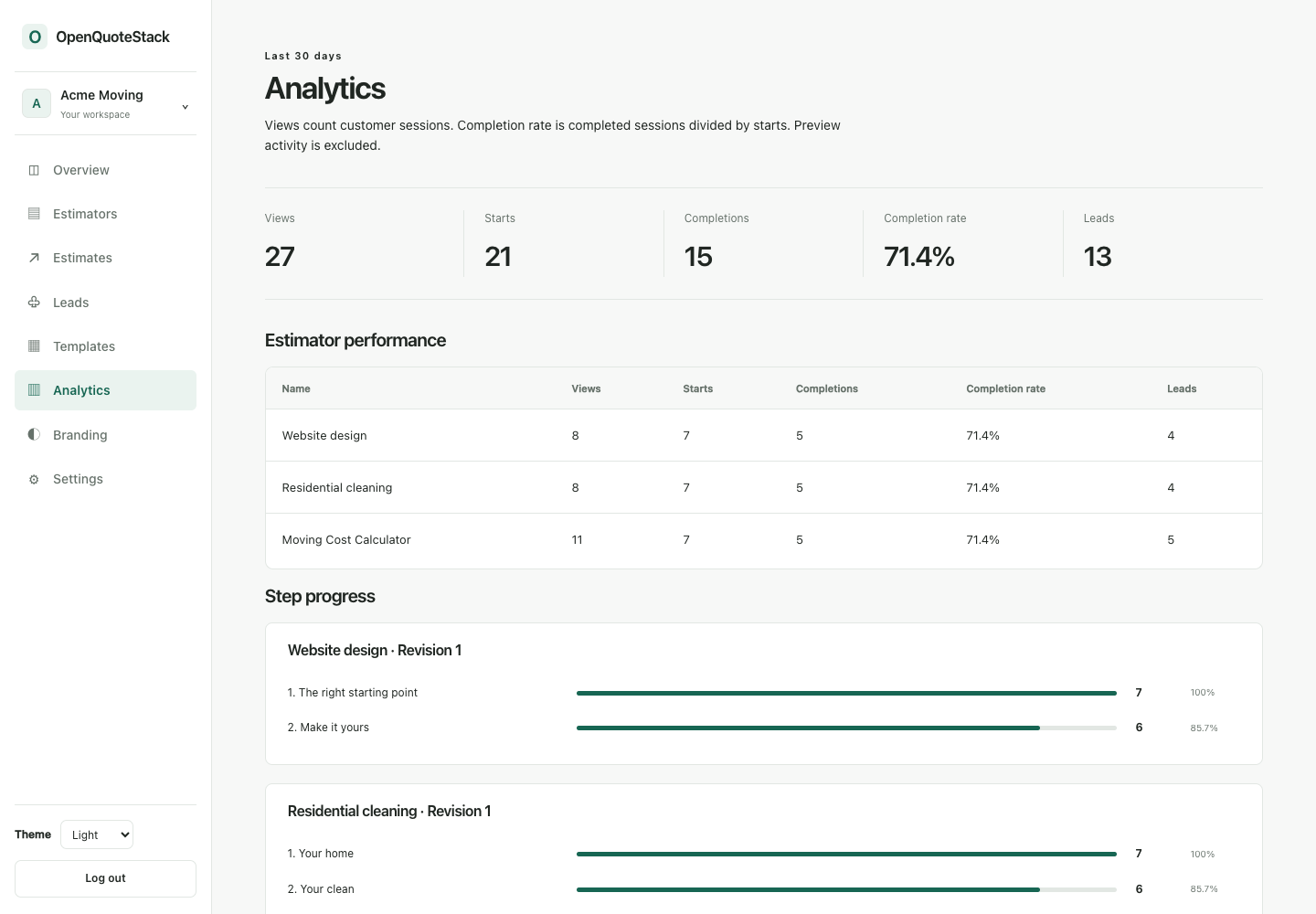
0.2.0-alpha.1 is an early public preview. Core authoring, customer quoting and developer integrations work; account recovery, invitations and data-erasure workflows are still planned. Read the limitations before accepting production customer data.
Quick start
git clone https://github.com/ReVG08/OpenQuoteStack.git
cd OpenQuoteStack
cp .env.example .env
# Replace the PostgreSQL password, authentication secret and encryption key.
# Use independent random hex values; match the password in DATABASE_URL.
docker compose up -d --build
Open http://localhost:3000, create an account and organization, select a template,
customize questions/prices, preview and publish. Completed customer quotes appear
under Estimates with their original revision and calculation breakdown. No default
account or password is installed. PostgreSQL and brand images persist in named
volumes; a separate worker delivers integrations.
Use Docker installation for credentials, alternate ports, TLS, health checks and upgrades. Public deployments require an HTTPS origin. Linux/Caddy/Nginx and hosting-panel recipes are documented.
Product
- Visual multi-step authoring with pointer/keyboard sorting, validation and AND/OR visibility.
- Fixed, per-unit, conditional, tiered and percentage pricing; minimums, maximums, ranges, weekday adjustments and advanced safe formulas.
- Exact monetary arithmetic and ordered, itemized explanations.
- Editable drafts, immutable publication snapshots and explicit rollback.
- Branded mobile calculators with progress and configurable contact capture.
- Estimates, statuses, internal notes, editable contacts and first-party conversion reports.
- Normalized logos/favicons, live branding preview and professional estimate PDFs.
- English/Brazilian Portuguese core product copy; light/dark/system admin appearance.
- Email/password accounts, database sessions, organization permissions and tenant isolation.
Three portable examples demonstrate different pricing patterns:
| Template | Demonstrates |
|---|---|
| Moving company | Bedrooms/distance, stairs, piano, weekend surcharge and minimum |
| Residential cleaning | Rooms/size, recurring discount, deep cleaning and add-ons |
| Web design / agency | Package choices, pages, optional functionality, rush fee and ranges |
Example prices and measurement units need review before publication. Template
currency selection preserves example major-unit values without exchange conversion.
Validated .oqs.json imports create a new identity; exports contain declarative
configuration without leads or credentials. See the product workflow
and template authoring guide.
Developer platform
The REST API v1 exposes tenant-scoped estimator, estimate and lead resources. Owners/admins create hashed, scoped keys and revoke them in Settings. Submissions calculate on the server, retain their published revision and support transactional idempotency. Responses use stable representations, pagination and request IDs.
import { OpenQuoteStack } from "@openquotestack/sdk";
const oqs = new OpenQuoteStack({
  baseUrl: "https://quotes.example.com",
  apiKey: process.env.OPENQUOTESTACK_API_KEY!,
});
const page = await oqs.estimators.list();
Signed webhooks use timestamped HMAC, durable delivery records and bounded retries. PostgreSQL jobs handle delivery outside customer requests; Redis is not required. Optional SMTP sends branded notifications, confirmations and estimates.
Embedding supports iframes and a small JavaScript loader with automatic height and explicit framing permissions. Custom domains use tenant DNS verification; operators configure routing and TLS. Brand assets use local storage by default or an S3-compatible adapter. Audit records and authenticated system status help operators inspect changes.
Engine and Schema
import { parseEstimator } from "@openquotestack/schema";
import { calculateEstimate } from "@openquotestack/engine";
const estimator = parseEstimator(document);
const result = calculateEstimate(estimator, answers);
// result.totalMinor, lineItems, adjustments, range, metadata
The engine depends only on Schema. It has no React, database, authentication, network, browser, implicit clock or locale dependency. Prices use integer minor units with exact rational intermediates and explicit currency exponents. Formatting belongs to the caller. Formulas use a controlled AST, never arbitrary JavaScript.
Engine, Schema and SDK are ESM packages with TypeScript declarations, prepared for publication. They are not published externally as part of repository preparation. Small working examples live under examples.
Local development
Use Node.js 24, pnpm 10.34.6 and PostgreSQL 18.
corepack enable
corepack prepare pnpm@10.34.6 --activate
pnpm install --frozen-lockfile
pnpm setup:env
# Start PostgreSQL in another terminal: pnpm db:local
# Or: docker compose up -d db
pnpm db:migrate
pnpm dev
The environment helper refuses to overwrite existing configuration. Match
DATABASE_URL to your database. pnpm db:local is development-only and retains a
loopback cluster under ignored .local/postgres. For port 3001, set
BETTER_AUTH_URL=http://localhost:3001, generate/build packages, then run
pnpm --filter @openquotestack/web dev --port 3001. Restart after environment changes.
Run pnpm worker separately for local background delivery.
After pnpm build, pnpm --filter @openquotestack/web start runs the standalone
server with copied public/static assets; --port 3001 selects an alternate port.
Optional demo seeding needs an existing registered account. Set SEED_OWNER_EMAIL
and run SEED_DEMO=1 pnpm db:seed. It creates a separate fictional Acme Moving
workspace with three estimators and sample activity, preserving existing seeded data.
The public /demo playground is browser-only; published calculators save quotes.
pnpm templates:validate
pnpm example
pnpm test
pnpm test:database
pnpm typecheck
pnpm lint
pnpm format:check
pnpm build
Integration tests require a disposable database ending in _test and truncate
fixtures. Never use retained or production credentials. See verification.
Architecture and operations
| Location | Responsibility |
|---|---|
apps/web | Next.js UI, HTTP, authentication and public rendering |
packages/schema | Portable definitions and runtime validation |
packages/engine | Deterministic pricing and explanations |
packages/sdk | Typed API client, local facade and webhook verification |
packages/database | Prisma migrations, authorized transactions, outbox/jobs and adapters |
packages/core | Permissions, events and shared domain utilities |
packages/ui | Components and theme tokens |
packages/config | Strict TypeScript configuration |
Read the architecture, domain model and ADRs. The documentation index covers installation, configuration, pricing, integrations, security and contribution. Back up PostgreSQL, assets and encryption secrets. No hidden application telemetry or required third-party analytics is included; see privacy and data flows.
Current limitations
Account verification/password recovery, invitations and team administration are not implemented. Recent-record administrative lists are bounded; broad search and pagination are planned. Customer-data retention/erasure needs an explicit workflow. This release has no zero-downtime upgrade guarantee or independent security certification. Hosting-panel recipes and broader object-storage provider compatibility need further testing. Mapping, customer uploads, payments, booking and CRM are outside current scope.
Contributing and license
See CONTRIBUTING.md, ROADMAP.md, CHANGELOG.md and SECURITY.md.
GNU Affero General Public License v3.0 only, SPDX AGPL-3.0-only.
Commercial use and white labeling are permitted under the license. Modified
network-served versions carry corresponding-source obligations. Public packages
use the same license; review compatibility before embedding them in proprietary
software. See ADR-0011.